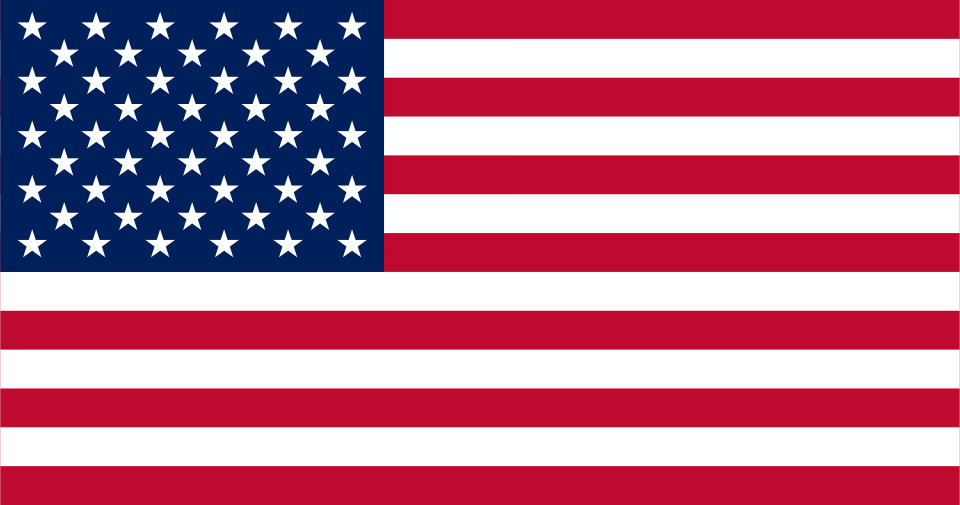
United States
340,110,988
people
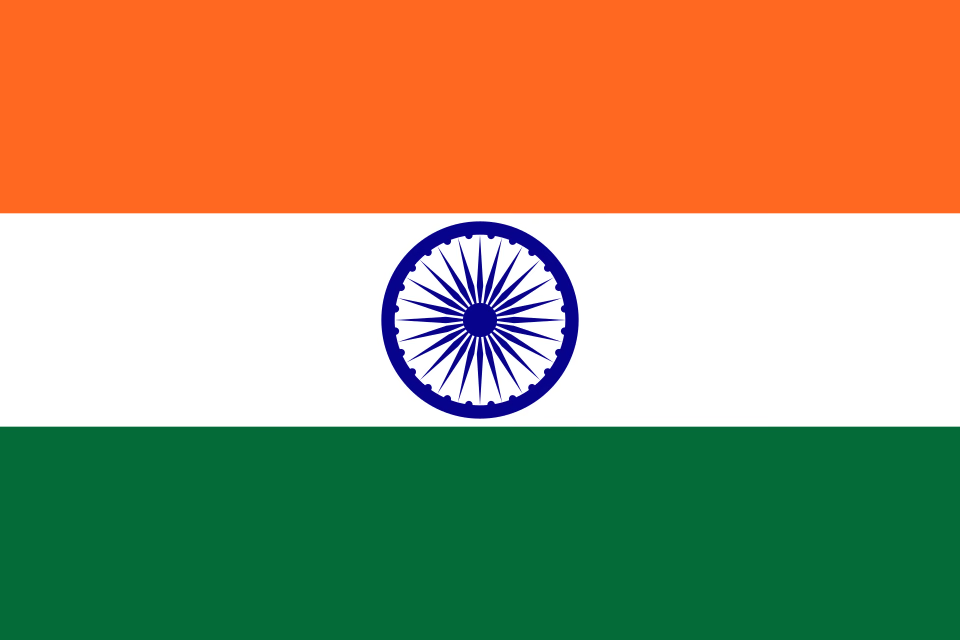
India
?
more, or less?
Population
Two of 197 — one shows its people, the other hides it. Say whether the hidden one is more or less and keep going. A tie counts as correct; one wrong answer ends the run, including a near miss within 10%.
The map most people carry is a map of land. It was learned from a wall chart or a globe, it rewards whichever country takes up the most room, and it has nothing to say about how many people are standing on that room. Asked which of two countries is bigger, the mind answers the question it has an answer to. Russia is enormous on every map ever printed, so Russia feels populous. Bangladesh is a small green shape at the top of the Bay of Bengal, so it does not. On the figures in this pack, Bangladesh has around 25 million more people than Russia, in a little under a hundredth of the land.
The second map is a map of attention. Countries that appear in the news, win things, or used to run large parts of the world take up more space in memory than their populations would give them, and the correction runs the other way for the places that rarely come up.
Why the intuition fails
Land and fame fail in the same direction, which is why the errors stack rather than cancel. Canada is the second-largest country by area and one of the most familiar names in the English-speaking world. Uganda is about a fortieth of its size and makes the news far less often. Uganda has more people. So does Nigeria than Russia, by a margin larger than the whole population of Spain.
What the guess needs is a sense of density and a sense of growth, and neither is on any map. The countries that have grown fastest in living memory are mostly in Africa and South Asia, while many of the ones that shaped the mental map have barely grown at all. A picture of the world absorbed in childhood is therefore not just coarse but dated, and it errs by overrating the places that have stood still.
The smallest states break the intuition from the other end. A name on a flag feels like a country of millions, and some of them would fit inside a market town. The Vatican has fewer people than many secondary schools.
What the data is and what it is not
The figures do not come from one year, and that is the pack’s real weakness. About one in five dates from 2017 or earlier, and the oldest is from 2005. A country counted recently is set against one counted a decade ago as though the two were contemporaries, and when two populations are close, the order on the card can be the order of the counts rather than of the countries.
The sharpest case sits at the top of the list. At the September 2026 retrieval, the figure Wikidata ranks first for India is a 2020 estimate, and China’s is from 2025. Five years separate two numbers that are within six per cent of each other, so the comparison the pack makes is between India five years ago and China now.
Rank, not date, decides which figure is used, and the two do not always agree. Canada’s first-ranked figure is its 2021 census count of just under 37 million, while a figure of 40 million from 2023 sits on the record one rank below it. The pack shows the census, because that is the number the record puts forward — which makes it a pack about what the record says, and occasionally a few years behind the world.
Questions
- Why these 197 countries?
- They are the sovereign states as Wikidata classifies them, excluding former ones: the 193 members of the United Nations, plus Taiwan, Kosovo, Palestine and the Vatican. There is no population floor and no fame filter, so the smallest states are in. The definition is Wikidata’s rather than the UN’s on purpose. A membership filter looks cleaner and is not — Taiwan’s UN seat ended in 1971, but the record of it is still read as current, so the “193” query returns 194.
- How accurate are the figures?
- Each is the figure Wikidata ranks highest for that country, taken as recorded. Some are census counts, most are official estimates, and they come from different years — the provenance block below gives the oldest. Wikidata’s ranking is an editor’s judgement, so a country can carry a newer figure that nobody has yet promoted above an older one, and where that happens this pack uses the older one.
- Why is a figure years out of date?
- Because that is the most recent figure Wikidata ranks first for that country, and this pack does not replace one source’s number with another’s. Mixing in estimates from elsewhere would mean choosing, country by country, which estimate to believe — a judgement with no receipt. When the record is updated, the next regeneration picks the new figure up.
- Why is the Vatican in here?
- Because it is a sovereign state, and leaving out the small ones would need a threshold the source does not have. The consequence is that some rounds are easy — a microstate against a large country is not a close call — and that is kept deliberately. Several of the states near the bottom are places most people have never had a reason to look up.
- Does the pack change?
- Yes. Population is the kind of figure that goes out of date, so the pack is marked volatile and due a review once a year. A regeneration re-runs the same query and rewrites only what changed, so a country moves when its recorded figure does. The list of countries changes only when Wikidata’s list of sovereign states does.
- Can I play it without JavaScript?
- You can read all of it and see the opening pair, because the page is built as HTML before anything runs. Guessing needs JavaScript, since there is no server to send a guess to.
Where the figures come from
Wikidata, under CC0 1.0. Retrieved 2026-09-15.
The sovereign states as Wikidata classifies them, excluding former ones, with no population floor. Names are Wikidata's English labels, except where a label is the formal style of the name players use: the People's Republic of China appears as China. Each figure comes from the country's highest-ranked population statements, so a newer figure Wikidata ranks below an older one is not used. Where more than one statement shares the top rank, the figure is the one with the most recent point in time — not the largest, which would report a decade-old census wherever a population has fallen. The figures are not all from the same year: asOf records the oldest in the set.
Image credits
China — Zeng Liansong, Public domain, source.
India — Government of India, Public domain, source.
United States — Vector file created by Dbenbenn , Zscout370 , Jacobolus , Indolences , and Technion ., Public domain, source.
Indonesia — Jayakatwang, Public domain, source.
Pakistan — User:Zscout370, Public domain, source.
Brazil — Raimundo Teixeira Mendes, Public domain, source.
Nigeria — Jon Harald Søby ., Public domain, source.
Bangladesh — Public domain, source.
Russia — Peter the Great, Public domain, source.
Mexico — Alex Covarrubias , 9 April 2006. Based on the arms by Juan Manuel Gabino Villascán., Public domain, source.
Ethiopia — Drawn by User:SKopp, Public domain, source.
Japan — Public domain, source.
Egypt — Public domain, source.
Philippines — Public domain, source.
Democratic Republic of the Congo — Nightstallion, Public domain, source.
Vietnam — Public domain, source.
Iran — SVG file: SiBr 4 Designer: Hamid Nadimi Construction: ISIRI, Public domain, source.
Turkey — David Benbennick (original author), Public domain, source.
Germany — User:SKopp , User:Madden , and other users, Public domain, source.
France — Original: Unknown Vector: SKopp, Public domain, source.
United Kingdom — Original: Acts of Union 1800 Vector: Yaddah, Public domain, source.
South Africa — Flag design by Frederick Brownell , image by Wikimedia Commons users, Public domain, source.
Italy — Public domain, source.
Tanzania — Public domain, source.
Myanmar — Public domain, source.
Colombia — Public domain, source.
South Korea — Original: Government of the Republic of Korea Vector: Great Brightstar and others, Public domain, source.
Spain — Public domain, source.
Kenya — User:Pumbaa80, Public domain, source.
Argentina — Manuel Belgrano, Public domain, source.
Uganda — tobias, Public domain, source.
Algeria — Original: National Liberation Front of Algeria Vector: SKopp, Public domain, source.
Afghanistan — Original: Taliban Vector: Lexicon, Public domain, source.
Ukraine — Government of Ukraine, Public domain, source.
Sudan — Public domain, source.
Iraq — Public domain, source.
Poland — Public domain, source.
Canada — Public domain, source.
Morocco — Denelson83 , Zscout370, Public domain, source.
Angola — Original: Henrique de Carvalho Santos Vector: SKopp, Public domain, source.
Uzbekistan — Farhod Yoʻldoshev, Public domain, source.
Malaysia — MapGrid (old version SKopp , Zscout370 and Ranking Update ), Public domain, source.
Peru — David Benbennick, Public domain, source.
Saudi Arabia — The Shura Council, Public domain, source.
Ghana — Theodosia Okoh, Public domain, source.
Madagascar — Public domain, source.
Venezuela — Public domain, source.
Ivory Coast — Public domain, source.
Mozambique — FRELIMO, Public domain, source.
Nepal — Drawn by Pumbaa80 , Achim1999, Public domain, source.
Cameroon — (of code) -xfi-, Public domain, source.
Yemen — Public domain, source.
Australia — Unknown (Vector graphics image by Ian Fieggen ) (only minor code changes by uploader.), Public domain, source.
North Korea — Original: Unknown author Vector: Zscout370, Public domain, source.
Syria — Public domain, source.
Taiwan — Sun Yat-sen, Public domain, source.
Burkina Faso — Drawn by SKopp , rewritten by Gabbe and Андрей Перцев, Public domain, source.
Niger — Made by: Philippe Verdy User:verdy_p , see also fr:Utilisateur:verdy_p ., Public domain, source.
Sri Lanka — Original: Sri Lanka Vectorization: Zscout370, Mike Rohsopht, Public domain, source.
Kazakhstan — Shaken Niyazbekop, Public domain, source.
Zambia — Gabriel Ellison, Public domain, source.
Chile — Public domain, source.
Chad — SKopp & others (see upload log), Public domain, source.
Malawi — Original: Unknown author Vector: Achim1999, Public domain, source.
Guinea — Public domain, source.
Cambodia — Public domain, source.
Kingdom of the Netherlands — Zscout370, Public domain, source.
Ecuador — Public domain, source.
Senegal — Original upload by Nightstallion, Public domain, source.
Zimbabwe — Public domain, source.
Rwanda — Original: Unknown Vector: Zscout370, Public domain, source.
Benin — Drawn by User:SKopp , rewritten by User:Gabbe, Public domain, source.
Burundi — Public domain, source.
Bolivia — Public domain, source.
Belgium — Dbenbenn and others, Public domain, source.
Tunisia — Various Wikimedia Commons' contributors, Public domain, source.
Somalia — Public domain, source.
Cuba — Miguel Teurbe Tolón and Narciso López, Public domain, source.
Haiti — Public domain, source.
Czech Republic — Jaroslav Kursa, Public domain, source.
Dominican Republic — Juan Pablo Duarte, Public domain, source.
Sweden — Jon Harald Søby and others., Public domain, source.
Greece — Public domain, source.
Jordan — Public domain, source.
Portugal — Original: Columbano Bordalo Pinheiro Vector: Vítor Luís Rodrigues, António Martins-Tuválkin, Public domain, source.
Azerbaijan — SKopp and others, Public domain, source.
United Arab Emirates — Abdulla Mohammed Al Maainah, Public domain, source.
Israel — Public domain, source.
Tajikistan — Public domain, source.
Switzerland — Original: Unknown Vector: User:Marc Mongenet Credits: User:-xfi- User:Zscout370, Public domain, source.
Belarus — Public domain, source.
Austria — Bundesministerium für Landesverteidigung, Public domain, source.
Papua New Guinea — User:Nightstallion, Public domain, source.
Togo — Sangjinhwa, Public domain, source.
Sierra Leone — Zscout370, Public domain, source.
Libya — Public domain, source.
Kyrgyzstan — Shakiev N.T., Primov U.B., Public domain, source.
Paraguay — Republica del Paraguay, Public domain, source.
Serbia — Public domain, source.
Republic of the Congo — Public domain, source.
Turkmenistan — Public domain, source.
Lebanon — Henri Pharaon, Public domain, source.
El Salvador — Public domain, source.
Kingdom of Denmark — Madden and others, Public domain, source.
Singapore — Original: Government of Singapore Vector: Zscout370, Public domain, source.
Finland — Public domain, source.
Norway — Original: Fredrik Meltzer Vector: Gutten på Hemsen, Public domain, source.
Slovakia — Original: Ladislav Čisárik and Ladislav Vrtel Vector: SKopp, Public domain, source.
New Zealand — Public domain, source.
Costa Rica — Public domain, source.
Palestine — Orionist , previous versions by Makaristos , Mysid , etc., Public domain, source.
Liberia — Government of Liberia, Public domain, source.
Central African Republic — Barthélemy Boganda, Public domain, source.
Ireland — Éire, Public domain, source.
Oman — Government of Oman, OGL-om 1.0, source.
Mauritania — Public domain, source.
Panama — Zscout370 et al., Public domain, source.
Kuwait — Public domain, source.
Georgia — Last update by MapGrid SKopp, Public domain, source.
Croatia — Public domain, source.
Bosnia and Herzegovina — Mladen Kolobarić, Public domain, source.
Eritrea — Public domain, source.
Uruguay — Public domain, source.
Mongolia — Public domain, source.
Armenia — Original: Stepan Malkhasyants Vector: SKopp, Public domain, source.
Lithuania — Public domain, source.
Albania — Sadik Kaceli, Public domain, source.
Jamaica — Public domain, source.
The Gambia — Public domain, source.
Qatar — Public domain, source.
Namibia — SVG by Vzb83~commonswiki et al., Public domain, source.
Botswana — SKopp , Gabbe , Madden, Public domain, source.
Moldova — Gheorghe Vrabie, Public domain, source.
Slovenia — Original: Marko Pogačnik Vector: Achim1999, Public domain, source.
Gabon — Léon Augé and Pierre Claver Eyeghe, Public domain, source.
Lesotho — Public domain, source.
Guinea-Bissau — Public domain, source.
Equatorial Guinea — Public domain, source.
Latvia — Original: Ansis Cīrulis Vector: SKopp, Public domain, source.
North Macedonia — User:SKopp , redrawn by User:Gabbe, Public domain, source.
Kosovo — Cradel (current version), earlier version by Ningyou, Public domain, source.
Bahrain — Source: Drawn by SKopp , rewritten by Zscout370, Public domain, source.
Timor-Leste — Public domain, source.
Estonia — Original: Unknown author Vector: SKopp , PeepP and others, Public domain, source.
Trinidad and Tobago — Public domain, source.
Cyprus — İsmet Güney , SVG by User:Vzb83~commonswiki, Public domain, source.
Eswatini — Sobhuza II, Public domain, source.
Djibouti — Public domain, source.
Fiji — Tessa Mackenzie, Public domain, source.
Comoros — Public domain, source.
Guyana — Whitney Smith, Public domain, source.
Bhutan — Public domain, source.
Luxembourg — Drawn by User:SKopp, Public domain, source.
Montenegro — B1mbo , Froztbyte , Great Brightstar, Public domain, source.
Solomon Islands — User:SKopp, Public domain, source.
Suriname — Public domain, source.
Cape Verde — Original: Pedro Gregório Vector: SKopp, Public domain, source.
Malta — Public domain, source.
Brunei — Nightstallion, Public domain, source.
Maldives — Public domain, source.
Belize — Caleb Moore, Public domain, source.
The Bahamas — Government of Bahamas, Public domain, source.
Iceland — Original: Matthías Þórðarson Vector: Árni Dagur and Magasjukur2, Public domain, source.
Barbados — User:Denelson83, Public domain, source.
Vanuatu — Kalontas Mahlon, Public domain, source.
São Tomé and Príncipe — Public domain, source.
Samoa — Public domain, source.
Saint Lucia — Dunstan St Omer, Public domain, source.
Kiribati — User:Hanzlan, Public domain, source.
Seychelles — User:Vxb83, Public domain, source.
Grenada — Public domain, source.
Saint Vincent and the Grenadines — Public domain, source.
Tonga — Uelingatoni Ngu Tupoumalohi, Public domain, source.
Antigua and Barbuda — Original: Sir Reginald Samuel Vector: David Benbennick, Public domain, source.
Andorra — Original: Napoleon III Vector: HansenBCN, Public domain, source.
Federated States of Micronesia — Public domain, source.
Dominica — Alwin Bully, Public domain, source.
Marshall Islands — Public domain, source.
Saint Kitts and Nevis — Edrice Lewis, Public domain, source.
Monaco — Drawn by User:SKopp, Public domain, source.
Liechtenstein — Mnmazur and others, Public domain, source.
Palau — Original: John Blau Skebong Vector: Nightstallion, Public domain, source.
Nauru — User:Skimel, Public domain, source.
Tuvalu — Public domain, source.
Vatican City — Goran_tek-en, Public domain, source.


.svg)


.svg)


.svg)


.svg)

.svg)


.svg)


.svg)
.svg)


.svg)


.svg)