Fisht Olympic Stadium
Sochi, Russia
?
more, or less?
Stadium capacity
Two of 166 — one shows its seats, the other hides it. Say whether the hidden one is more or less and keep going. A tie counts as correct; one wrong answer ends the run, including a near miss within 10%.
Nobody who has stood in a stadium has any idea how many people were in it. The number arrives afterwards, read out over the tannoy or printed in the paper, and it never feels like the right number. What the body registers instead is noise, steepness and how far away the far stand looks, and none of those is a headcount. So the size a ground has in memory is a record of how it felt — how loud it got, how often it was on television, how large the club that plays there seemed — and the seats are the one thing nobody counted.
That is why the comparisons in this pack are harder than they have any right to be for anyone who watches sport. Twickenham holds more people than Old Trafford. Celtic Park and the Emirates Stadium are seventeen seats apart. Stamford Bridge is smaller than Villa Park.
Why the intuition fails
A club’s fame and its ground’s size are measured in different centuries. A stadium is built once and then lived in for decades, often on a site hemmed in by terraced streets that were there first, while the club inside it can grow into something global without the walls moving at all. Chelsea is the clearer case in this pack than any argument: a club with a worldwide following in a ground that has been squeezed between a railway and a main road for over a century.
The second distortion is older. For most of the twentieth century, the famous grounds were counted in standing places, and a terrace holds far more people per yard than a row of seats. The legendary crowds — the ones that fixed a ground’s size in a generation’s memory — were standing crowds. When English top-flight grounds became all-seater in the 1990s, many of them lost a large share of their capacity, while their reputations kept the old numbers.
The third runs the other way. Grounds built for other sports, and for tournaments, sit outside a football supporter’s mental league table altogether. The Melbourne Cricket Ground seats more than a hundred thousand people, and it is not a football ground at all.
What the data is and what it is not
The list leans towards the grounds that have been written about most, in the most languages, which means big European clubs and anything that has hosted a World Cup. Stadiums built for recent tournaments clear that bar easily. Murrayfield and Croke Park, each the national stadium of its country for generations, do not.
The capacities are only as good as the record, and the record is uneven. Some are cited to the club or the operator and stated to the seat. Others are round thousands with no reference at all, and at the September 2026 retrieval the largest figure in the pack was one of those. The pack shows it anyway, because the only alternative is a person choosing which figures to believe, and that would make every capacity here an opinion.
What nearly went wrong was the stadiums that state several capacities at once. Taking the largest looked harmless until the largest turned out to be a concert layout, a Super Bowl configuration, or a figure from 1896.
Questions
- What does capacity mean here?
- The capacity Wikidata records for the stadium, as a count of places, and it is meant to be the everyday figure. It is not a record attendance, which for older grounds can be far higher than anything they hold now. Where a stadium’s record gives more than one capacity with nothing to say which is the everyday one, the stadium is left out rather than given a number somebody had to choose.
- Why is my ground missing?
- The likeliest reason is that it holds fewer than 25,000. After that: it has fewer than 40 pages across Wikimedia’s projects, which is the bar for recognisable; its record gives more than one capacity; it has been demolished; or nobody has published a freely licensed photograph of it, since every card here carries one. Several well-known grounds are missing for the last two reasons alone.
- How accurate are the capacities?
- They are the figures on the record, and they are as good as its references. Many are stated precisely and cited; some are a round number with no source attached. Capacity is also less fixed than it sounds — it moves with renovations, with safety certificates, and with whether a section is open that season — so a figure can be right about a stadium and still out of date by a few thousand.
- Why is the Colosseum in here?
- Because Wikidata classes an amphitheatre as a kind of stadium, the Colosseum is not recorded as demolished, and its record gives it a capacity. That figure is a historians’ estimate of the crowd it held in antiquity rather than a count of seats anyone could sit in today. It is kept, because the rule that let it in is the same one that admits every other ground, and a pack that quietly removed the awkward item would be a pack with an editor it did not mention.
- Does the pack change?
- Rarely. A stadium’s capacity is stable between renovations, so the pack is marked evergreen rather than given a refresh timer. What ages is the list: grounds are built, rebuilt and demolished, and a club that moves leaves its old stadium behind. A regeneration re-runs the same query and rewrites only what changed.
- Can I play it without JavaScript?
- You can read all of it and see the opening pair, because the page is built as HTML before anything runs. Guessing needs JavaScript, since there is no server to send a guess to.
Where the figures come from
Wikidata, under CC0 1.0. Retrieved 2026-09-15.
Stadiums and multi-purpose stadiums seating at least 25,000, restricted to those with at least 40 Wikimedia sitelinks so every item is recognisable on sight (brief §15). Demolished venues are excluded. Capacities are taken from the best-ranked statement and only where the figure is stated in seats. A stadium whose best-ranked statements still give more than one capacity — usually a concert or special-event configuration beside the everyday one — is left out rather than given a number we would have to choose. A stadium with no freely licensed photograph of it anywhere is left out too, so every card carries one. Where Wikidata’s label is a name the stadium no longer goes by, the card shows the one in use now, and the location beneath each name is written by hand.
Image credits
Estadio Azteca (Mexico City, Mexico) — ProtoplasmaKid, CC BY 4.0, source.
Rungrado 1st of May Stadium (Pyongyang, North Korea) — Nicor, derivative work by Hic et nunc, CC BY-SA 3.0, source.
Camp Nou (Barcelona, Spain) — Oh-Barcelona.com from Barcelona, Spain, CC BY 2.0, source.
Melbourne Cricket Ground (Melbourne, Australia) — Flickerd, CC BY-SA 4.0, source.
FNB Stadium (Johannesburg, South Africa) — Dundas Football Club, CC BY 2.0, source.
Wembley Stadium (London, England) — Arne Müseler / www.arne-mueseler.com, CC BY-SA 3.0 de, source.
Education City Stadium (Al Rayyan, Qatar) — Korea.net / Korean Culture and Information Service (Heo Manjin), CC BY-SA 2.0, source.
Lusail Stadium (Lusail, Qatar) — Adnen1985, CC BY-SA 4.0, source.
Monumental Stadium (Buenos Aires, Argentina) — Fulviusbsas, CC BY-SA 4.0, source.
Accor Stadium (Sydney, Australia · formerly Stadium Australia) — Adam.J.W.C., CC BY-SA 2.5, source.
MetLife Stadium (New York, USA) — babyknight, CC BY 2.0, source.
Twickenham Stadium (London, England) — brewbooks from near Seattle, USA; cropped by Blackcat, CC BY-SA 2.0, source.
Signal Iduna Park (Dortmund, Germany · formerly Westfalenstadion) — Arne Müseler / www.arne-mueseler.com, CC BY-SA 3.0 de, source.
Stade de France (Paris, France) — Darthvadrouw, CC BY-SA 4.0, source.
Atatürk Olympic Stadium (Istanbul, Turkey) — Myrat, CC BY-SA 4.0, source.
Beijing National Stadium (Beijing, China) — N509FZ, CC BY-SA 4.0, source.
Maracanã Stadium (Rio de Janeiro, Brazil) — Arne Müseler / www.arne-mueseler.com, CC BY-SA 3.0 de, source.
Luzhniki Stadium (Moscow, Russia) — Mos.ru, CC BY 4.0, source.
Arrowhead Stadium (Kansas City, USA) — Ichabod, CC BY-SA 3.0, source.
San Siro (Milan, Italy) — Prelvini, CC BY-SA 4.0, source.
Old Trafford (Manchester, England) — Øyvind Vik, Public domain, source.
Allianz Arena (Munich, Germany) — Maximilian Dörrbecker ( Chumwa ), CC BY-SA 2.5, source.
Berlin Olympic Stadium (Berlin, Germany) — Thomas Wolf, www.foto-tw.de, CC BY-SA 3.0 de, source.
Principality Stadium (Cardiff, Wales · formerly Millennium Stadium) — Clint Budd from About 15 miles North of Swansea, Wales, CC BY 2.0, source.
Nissan Stadium (Yokohama, Japan · formerly International Stadium Yokohama) — Arne Müseler / www.arne-mueseler.com, CC BY-SA 3.0 de, source.
Estadio de La Cartuja (Seville, Spain) — V&A Dudush, CC BY 3.0, source.
NRG Stadium (Houston, USA · formerly Reliant Stadium) — User eschipul on Flickr, CC BY-SA 2.0, source.
Mercedes-Benz Stadium (Atlanta, USA) — Atlanta Falcons, CC BY 3.0, source.
Metropolitano Stadium (Madrid, Spain · formerly Wanda Metropolitano) — Fernandopascullo, CC BY-SA 4.0, source.
Stadio Olimpico (Rome, Italy) — Messapi , cropped by Blackcat, CC BY-SA 4.0, source.
SoFi Stadium (Los Angeles, USA) — Thank You (21 Millions+) views, CC BY 2.0, source.
Olimpiyskiy National Sports Complex (Kyiv, Ukraine) — Валерий Дед, CC BY 3.0, source.
Estádio Nacional de Brasília (Brasília, Brazil) — Arne Müseler / www.arne-mueseler.com, CC BY-SA 3.0 de, source.
Baku Olympic Stadium (Baku, Azerbaijan) — President.az, CC BY 4.0, source.
Athens Olympic Stadium (Athens, Greece) — Alterego, CC BY-SA 3.0, source.
Al Bayt Stadium (Al Khor, Qatar) — Kabhi2011, CC BY-SA 4.0, source.
Gillette Stadium (Boston, USA) — Bernard Gagnon, CC BY-SA 3.0, source.
Lincoln Financial Field (Philadelphia, USA) — Betp at French Wikipedia, CC BY-SA 3.0, source.
Levi's Stadium (San Francisco, USA) — Matthew Roth, CC BY-SA 2.0, source.
Estádio da Luz (Lisbon, Portugal) — Massimo Catarinella, CC BY 3.0, source.
Japan National Stadium (Tokyo, Japan) — Indiana jo, CC BY-SA 4.0, source.
Stade Vélodrome (Marseille, France) — Bernard Ddd, CC BY-SA 2.0, source.
Lumen Field (Seattle, USA) — "Smart Destinations", GoSeattleCard.com, and Go Seattle Card Blog, CC BY-SA 2.0, source.
Mineirão (Belo Horizonte, Brazil) — Rodrigo Lima/Portal da Copa, CC BY 2.0, source.
Colosseum (Rome, Italy) — FeaturedPics, CC BY-SA 4.0, source.
Munich Olympic Stadium (Munich, Germany) — Amrei-Marie, CC BY-SA 4.0, source.
Tottenham Hotspur Stadium (London, England) — Arne Müseler / www.arne-mueseler.com, CC BY-SA 3.0 de, source.
Moses Mabhida Stadium (Durban, South Africa) — Blastworlddbn, CC0, source.
Ellis Park Stadium (Johannesburg, South Africa) — Leglo09, CC BY-SA 2.0, source.
London Stadium (London, England · formerly Olympic Stadium) — Arne Müseler / www.arne-mueseler.com, CC BY-SA 3.0 de, source.
Veltins-Arena (Gelsenkirchen, Germany · formerly Arena AufSchalke) — Frank Vincentz, CC BY-SA 3.0, source.
Anfield (Liverpool, England) — Arne Müseler / www.arne-mueseler.com, CC BY-SA 3.0 de, source.
Celtic Park (Glasgow, Scotland) — Zhi Yong Lee from Glasgow, UK, CC BY 2.0, source.
Emirates Stadium (London, England) — Arne Müseler / www.arne-mueseler.com, CC BY-SA 3.0 de, source.
Estadio Centenario (Montevideo, Uruguay) — Marcelo Campi from Costa de Oro, Uruguay, CC BY-SA 2.0, source.
Stadion Maksimir (Zagreb, Croatia) — Suradnik13, CC BY-SA 4.0, source.
Parc Olympique Lyonnais (Lyon, France) — AsGunReview, CC BY-SA 4.0, source.
Cape Town Stadium (Cape Town, South Africa) — Hansueli Krapf, CC BY-SA 3.0, source.
Kazimierz Górski National Stadium (Warsaw, Poland) — XEvansGambitx, CC BY-SA 4.0, source.
Castelão (Fortaleza, Brazil) — Fábio Lima/Portal da Copa/Março de 2013, CC BY 3.0 br, source.
Lluís Companys Olympic Stadium (Barcelona, Spain) — Amadalvarez, CC BY 3.0, source.
National Arena (Bucharest, Romania) — Nowy Styl Group, CC BY-SA 4.0, source.
Rajko Mitić Stadium (Belgrade, Serbia · formerly Red Star Stadium) — User:Darwinek, CC BY-SA 3.0, source.
Johan Cruyff Arena (Amsterdam, Netherlands · formerly Amsterdam Arena) — Alf van Beem, CC0, source.
Stadio Diego Armando Maradona (Naples, Italy · formerly Stadio San Paolo) — Gaetano Capaldo, CC BY 4.0, source.
BC Place (Vancouver, Canada) — Quintin Soloviev, CC BY 4.0, source.
Strawberry Arena (Stockholm, Sweden · formerly Friends Arena) — Håkan Dahlström from Malmö, Sweden, CC BY 2.0, source.
San Mamés Stadium (Bilbao, Spain) — Валерий Дед, CC BY 3.0, source.
Etihad Stadium (Manchester, England) — Arne Müseler , cropped by Blackcat, CC BY-SA 3.0 de, source.
Rams Park (Istanbul, Turkey · formerly Türk Telekom Arena) — 1886kusagi, CC BY-SA 4.0, source.
Donbass Arena (Donetsk, Ukraine) — Валерий Дед, CC BY 3.0, source.
St James’ Park (Newcastle, England) — Arne Müseler / www.arne-mueseler.com, CC BY-SA 3.0 de, source.
Hampden Park (Glasgow, Scotland) — Dan Kearney, cropped by Blackcat, CC BY-SA 3.0, source.
Loftus Versfeld Stadium (Pretoria, South Africa) — legio09, CC BY-SA 2.0, source.
Aviva Stadium (Dublin, Ireland) — Arne Müseler / www.arne-mueseler.com, CC BY-SA 3.0 de, source.
Ibrox Stadium (Glasgow, Scotland) — Archibald99, Public domain, source.
De Kuip (Rotterdam, Netherlands) — Public domain, source.
Deutsche Bank Park (Frankfurt, Germany · formerly Waldstadion) — Arne Müseler / www.arne-mueseler.com, CC BY-SA 3.0 de, source.
Estadio Akron (Guadalajara, Mexico) — Juan Olivas, CC BY 2.0, source.
Şükrü Saracoğlu Stadium (Istanbul, Turkey) — Anl55400, CC BY-SA 4.0, source.
Khalifa International Stadium (Al Rayyan, Qatar) — Adnen1985, CC BY-SA 4.0, source.
Estádio do Dragão (Porto, Portugal) — Edgar Jiménez from Porto, Portugal, CC BY-SA 2.0, source.
King Baudouin Stadium (Brussels, Belgium · formerly Heysel Stadium) — Joni-Fuego, CC BY-SA 3.0, source.
Max-Morlock-Stadion (Nuremberg, Germany) — DerHans04, CC BY-SA 3.0, source.
Pierre Mauroy Stadium (Lille, France) — Felouch Kotek, CC BY-SA 4.0, source.
Ernst-Happel-Stadion (Vienna, Austria) — Arne Müseler / www.arne-mueseler.com, CC BY-SA 3.0 de, source.
Mestalla Stadium (Valencia, Spain) — Valencia CF, CC BY-SA 4.0, source.
Estádio Beira-Rio (Porto Alegre, Brazil) — Israel Heldt, CC BY 2.0, source.
Niedersachsenstadion (Hanover, Germany) — Arne Müseler / www.arne-mueseler.com, CC BY-SA 3.0 de, source.
Stadium of Light (Sunderland, England) — Arne Müseler / www.arne-mueseler.com, CC BY-SA 3.0 de, source.
Parc des Princes (Paris, France) — Валерий Дед, CC BY 3.0, source.
Arena Fonte Nova (Salvador, Brazil) — Portal da Copa/ME, CC BY 3.0 br, source.
Neo Química Arena (São Paulo, Brazil · formerly Arena Corinthians) — Alexandre Breveglieri, CC BY 2.0, source.
RheinEnergie Stadion (Cologne, Germany) — Raimond Spekking, CC BY-SA 4.0, source.
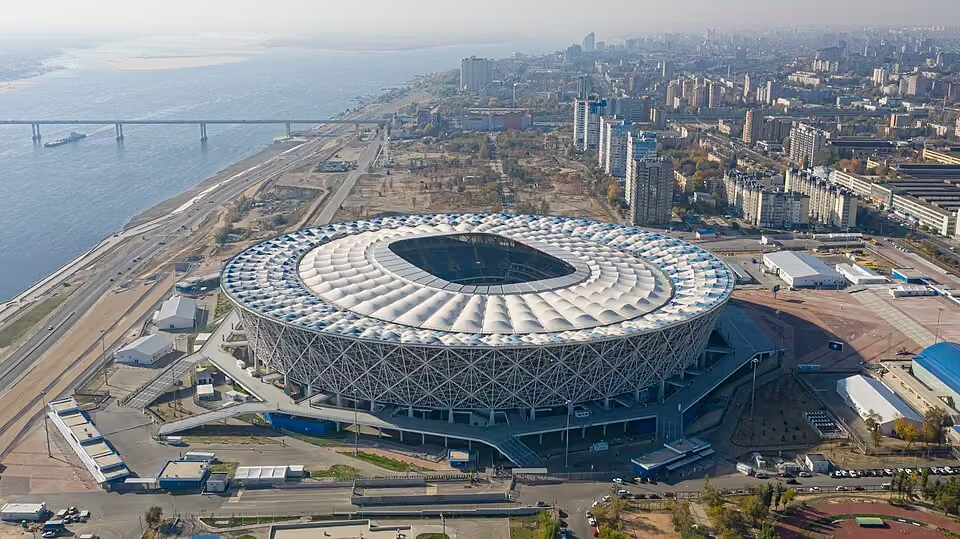
Volgograd Arena (Volgograd, Russia) — Arne Müseler / www.arne-mueseler.com, CC BY-SA 3.0 de, source.
Arena Pernambuco (Recife, Brazil) — Federação Pernambucana de Futebol from Brasil, Public domain, source.
Lukoil Arena (Moscow, Russia) — Voltmetro, CC BY-SA 4.0, source.
Free State Stadium (Bloemfontein, South Africa) — Graham Maclachlan, CC BY-SA 3.0, source.
Ak Bars Arena (Kazan, Russia · formerly Kazan Arena) — Government.ru, CC BY 4.0, source.
Rostec Arena (Kaliningrad, Russia · formerly Kaliningrad Stadium) — Dmitry Rozhkov, CC BY-SA 4.0, source.
Mordovia Arena (Saransk, Russia) — Vyacheslav Bukharov, CC BY-SA 4.0, source.
Arena das Dunas (Natal, Brazil) — Portal da Copa/ME, CC BY 3.0 br, source.
Rostov Arena (Rostov-on-Don, Russia) — Kremlin.ru, CC BY 4.0, source.
Samara Arena (Samara, Russia) — Satory2001, CC BY-SA 4.0, source.
Nizhny Novgorod Stadium (Nizhny Novgorod, Russia) — Bestalex, CC0, source.
Ramón Sánchez Pizjuán Stadium (Seville, Spain) — Niels98, CC BY-SA 4.0, source.
Mbombela Stadium (Mbombela, South Africa) — Tadpolefarm, CC BY-SA 4.0, source.
Stadio Artemio Franchi (Florence, Italy) — Sailko, CC BY 3.0, source.
Arena Pantanal (Cuiabá, Brazil) — Arne Müseler / www.arne-mueseler.com, CC BY-SA 3.0 de, source.
Arena Amazônia (Manaus, Brazil) — Arne Müseler / www.arne-mueseler.com, CC BY-SA 3.0 de, source.
Enea Stadion (Poznań, Poland) — Carte, CC BY-SA 3.0, source.
Tarczyński Arena (Wrocław, Poland) — Arne Müseler / www.arne-mueseler.com, CC BY-SA 3.0 de, source.
Villa Park (Birmingham, England) — Arne Müseler / www.arne-mueseler.com, CC BY-SA 3.0 de, source.
Stade Atlantique (Bordeaux, France) — Kevin M, CC BY 3.0, source.
Weserstadion (Bremen, Germany) — Arne Müseler, CC BY-SA 4.0, source.
Nelson Mandela Bay Stadium (Port Elizabeth, South Africa) — Ngrund, CC BY 2.0, source.
Helsinki Olympic Stadium (Helsinki, Finland) — Joneikifi, CC BY-SA 4.0, source.
Red Bull Arena (Leipzig, Germany) — Arne Müseler / www.arne-mueseler.com, CC BY-SA 3.0 de, source.
Royal Bafokeng Stadium (Rustenburg, South Africa) — 2010 World Cup - Shine 2010, CC BY 2.0, source.
Stade Geoffroy-Guichard (Saint-Étienne, France) — KevFB, CC BY-SA 3.0, source.
Stamford Bridge (London, England) — Arne Müseler / www.arne-mueseler.com, CC BY-SA 3.0 de, source.
Peter Mokaba Stadium (Polokwane, South Africa) — Brieuc Saffré, CC BY 2.0, source.
Allianz Stadium (Turin, Italy · formerly Juventus Stadium) — forzaq8 from kuwait, kuwait, CC BY 2.0, source.
Gdańsk Arena (Gdańsk, Poland) — Pawel Nurkowski, CC BY-SA 3.0, source.
Goodison Park (Liverpool, England) — Arne Müseler / www.arne-mueseler.com, CC BY-SA 3.0 de, source.
Metalist Stadium (Kharkiv, Ukraine) — Aleksandr Osipov, CC BY-SA 2.0, source.
Al Janoub Stadium (Al Wakrah, Qatar) — Palácio do Planalto from Brasilia, Brasil, CC BY 2.0, source.
Al Thumama Stadium (Doha, Qatar) — Adnen1985, CC BY-SA 4.0, source.
Hillsborough Stadium (Sheffield, England) — Arne Müseler / www.arne-mueseler.com, CC BY-SA 3.0 de, source.
St. Jakob-Park (Basel, Switzerland) — Chris Wachtler, CC BY-SA 4.0, source.
Stade Bollaert-Delelis (Lens, France) — Liondartois, CC BY-SA 4.0, source.
Parken Stadium (Copenhagen, Denmark) — Arne Müseler / www.arne-mueseler.com, CC BY-SA 3.0 de, source.
Elland Road (Leeds, England) — Arne Müseler , cropped by Blackcat, CC BY-SA 3.0 de, source.
Stadio Renzo Barbera (Palermo, Italy) — SonoGrazy, CC BY-SA 4.0, source.
Allianz Riviera (Nice, France) — Mirasol, CC BY-SA 3.0, source.
Stadion Poljud (Split, Croatia) — Quintin Soloviev, CC BY 4.0, source.
Arena Lviv (Lviv, Ukraine) — On tour, CC BY-SA 3.0, source.
Estádio Couto Pereira (Curitiba, Brazil) — Kevinklop at nl.wikipedia, CC BY-SA 3.0, source.
Toše Proeski Arena (Skopje, North Macedonia) — kallerna, CC BY-SA 4.0, source.
Karaiskakis Stadium (Piraeus, Greece) — TodorBozhinov, CC BY-SA 3.0, source.
Cardiff City Stadium (Cardiff, Wales) — Jon Candy from Cardiff, Wales, CC BY-SA 2.0, source.
Stadio Luigi Ferraris (Genoa, Italy) — Gabriel Rinaldi, CC BY-SA 4.0, source.
Stadium de Toulouse (Toulouse, France) — Luc-Éric Manneville Lucio fr, CC BY-SA 3.0, source.
Bramall Lane (Sheffield, England) — Arne Müseler / www.arne-mueseler.com, CC BY-SA 3.0 de, source.
St Mary's Stadium (Southampton, England) — Saint Mary's Stadium by David Dixon, CC BY-SA 2.0, source.
King Power Stadium (Leicester, England) — Pottercomuneo, CC BY-SA 4.0, source.
Stadion Wankdorf (Bern, Switzerland) — M.A., Public domain, source.
Red Bull Arena (Salzburg, Austria) — Arne Müseler / www.arne-mueseler.com, CC BY-SA 3.0 de, source.
Amex Stadium (Brighton, England) — Dominic Alves from Brighton, England, CC BY 2.0, source.
Molineux Stadium (Wolverhampton, England) — John Nickolls, CC BY-SA 2.0, source.
City Ground (Nottingham, England) — Arne Müseler / www.arne-mueseler.com, CC BY-SA 3.0 de, source.
Portman Road (Ipswich, England) — John Fielding from Norwich, UK, CC BY 2.0, source.
Stade de Genève (Geneva, Switzerland) — Vincenzo.togni, CC BY 4.0, source.
Volkswagen Arena (Wolfsburg, Germany) — Saubär, CC BY-SA 3.0, source.
Astana Arena (Astana, Kazakhstan) — ChelseaFunNumberOne, CC BY-SA 3.0, source.
Arena da Baixada (Curitiba, Brazil) — Gustavo Paolo, CC0, source.
Stadio Olimpico Grande Torino (Turin, Italy) — Asgaw, CC BY-SA 4.0, source.
bet365 Stadium (Stoke-on-Trent, England · formerly Britannia Stadium) — Gkbediako, CC BY-SA 4.0, source.
Carrow Road (Norwich, England) — Mls11 at English Wikipedia, Public domain, source.
The Hawthorns (West Bromwich, England) — Mattd1991, CC BY-SA 3.0, source.
Selhurst Park (London, England) — Arne Müseler / www.arne-mueseler.com, CC BY-SA 3.0 de, source.
Craven Cottage (London, England) — Kenneth Yarham, CC BY-SA 2.0, source.
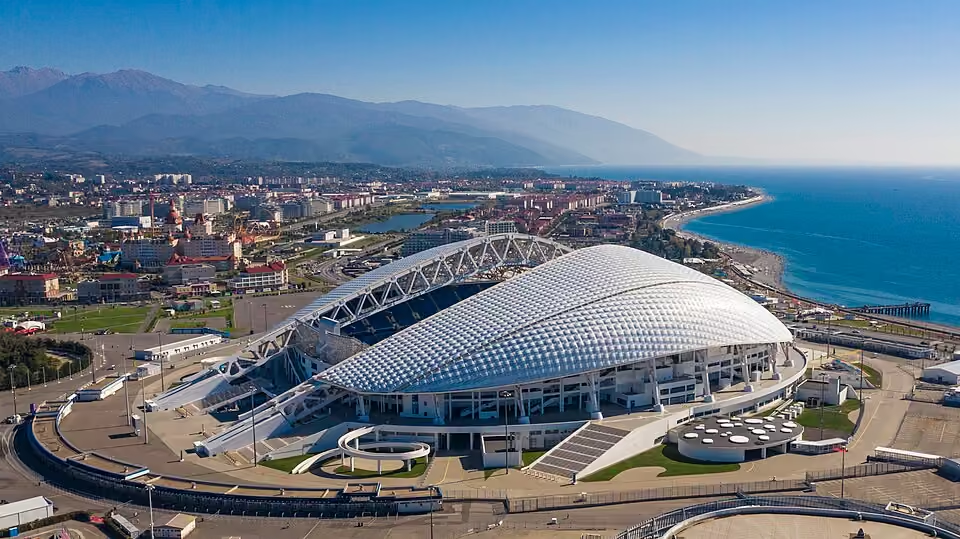
Fisht Olympic Stadium (Sochi, Russia) — Arne Müseler / www.arne-mueseler.com, CC BY-SA 3.0 de, source.
Letzigrund (Zurich, Switzerland) — Seasider53, CC BY 4.0, source.


.jpg)


.jpg)


.jpg)


.jpg)


.png)


.JPG)


.jpg)


.jpg)
.jpg)


_aerial_view_cropped.jpg)


.jpg)


X(3)0_Santa_Cruz_-_Pernambucano_BetNacional_2024.jpg)


.jpg)

.jpg)
.jpg)


.jpeg)


.jpg)


.jpg)


.jpg)
.jpg)

.JPG)


